Why Southern California Hard Water Demands Regular Descaling
Municipal tap water across the City of Long Beach, Lakewood, and coastal Los Angeles County is sourced from local groundwater wells and the Metropolitan Water District (Colorado River Aqueduct and State Water Project). This water is naturally rich in dissolved calcium carbonate and magnesium, measuring between 7 and 16 grains per gallon (GPG), categorizing it as moderately hard to very hard.
Unlike a standard tank water heater that stores 50 gallons in a large vessel, a tankless unit fires intense burners (up to 199,000 BTUs) instantly against compact, narrow heat exchanger fins. When hard water hits those red-hot tubes, the dissolved minerals immediately crystallize out and stick to the metal, creating an insulating layer of mineral scale.
Just 1/16 of an inch of limescale reduces heat transfer by over 15%, causing the burner to work harder, the internal sensors to overheat, and eventual pinhole heat exchanger fractures.
| Household Water Condition | Water Hardness (GPG) | Recommended Flush Cadence | Key Preventive Equipment |
|---|---|---|---|
| Standard Long Beach City Water | 8 – 11 GPG | Every 12 Months | Standard isolation valve kit flush |
| Hard Well / Groundwater Mix | 12 – 16+ GPG | Every 6 – 9 Months | Descaling flush + inline scale inhibitor |
| Equipped with Whole-Home Softener | 0 – 2 GPG | Every 24 – 36 Months | Periodic inspection & filter cleaning |
| High-Demand Commercial / Multi-Family | Variable | Every 6 Months | Dedicated automatic filtration system |
Warning Signs Your Tankless Water Heater Needs Flushing Now
Don't wait until your water turns ice cold in the middle of a shower. Watch for these common operational symptoms indicating that scale buildup has reached critical levels:
- Manufacturer Diagnostic Error Codes: Modern units monitor heat exchanger temperatures. Navien units will flash E003, E004, or E012 (flame or temperature sensor anomalies), Rinnai models display Code 11, Code 14, or LC (Scale Warning), and Noritz units display Code 11 or 90.
- Fluctuating Water Temperatures: The unit alternates between hot and cold (frequently called the 'cold water sandwich' effect) as internal safety switches cut burner output to prevent overheating.
- Noticeable Drop in Water Pressure: Scale deposits physically narrow the copper passageways, reducing gallons-per-minute (GPM) output at your showerheads and faucets.
- Unusual Kettling or Whistling Sounds: Steam bubbles struggling to force through constricted passages create high-pitched whistling or humming sounds.
If your unit is currently flashing diagnostic codes, connect with our tankless water heater repair team in Long Beach for immediate diagnosis and safe system clearance.
Step-by-Step: How a Professional Descaling Flush Works
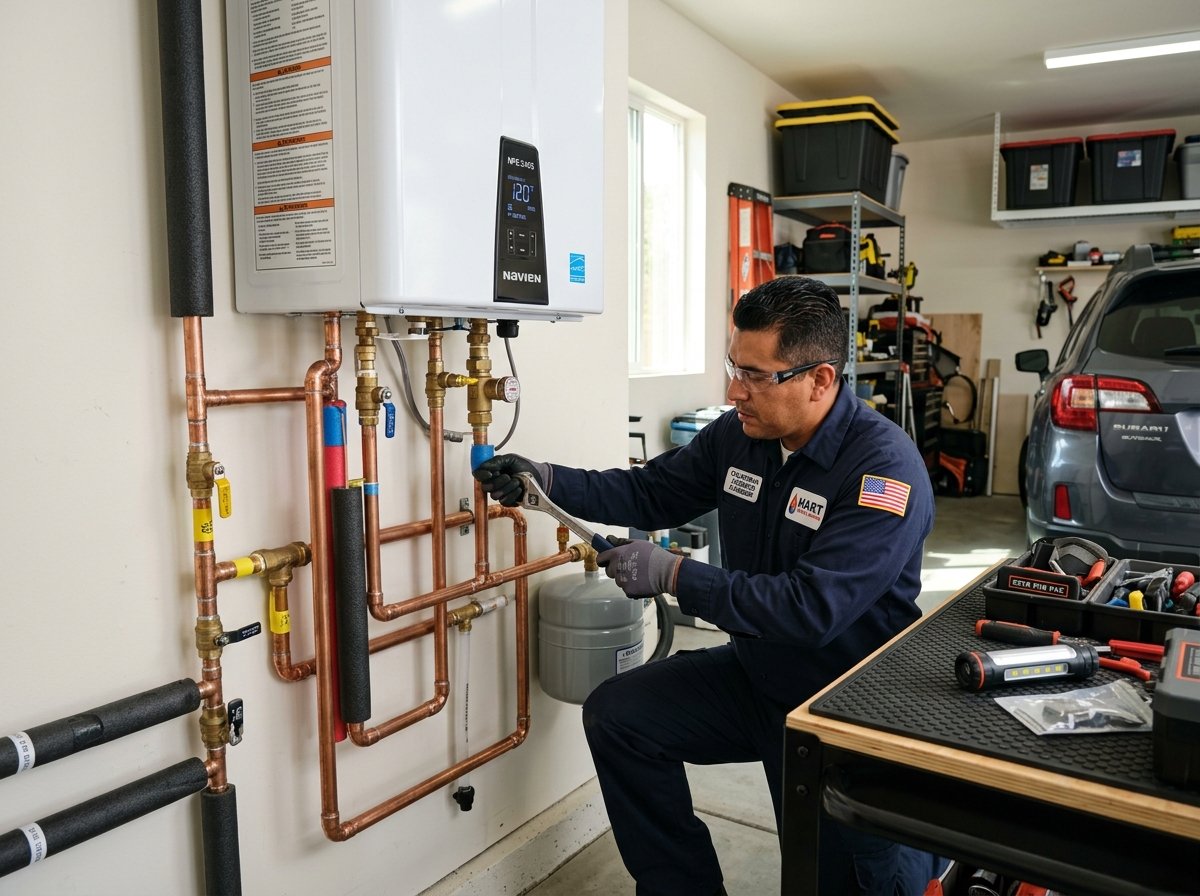
Descaling a tankless unit requires a dedicated isolation valve service kit (hot and cold service ports with T-handles). Here is the procedure certified plumbing technicians perform:
- Isolate the Heater: Turn off electrical power to the unit and close the main blue and red isolation valves, completely isolating the heater from your home's domestic plumbing.
- Connect Circulation Hoses: Attach two washing machine hoses to the threaded service port valves. Connect the cold service port to a 1/6 HP submersible utility pump placed in a 5-gallon bucket. Run the hot return hose back into the bucket.
- Add Food-Grade Descaling Solution: Pour 3 to 4 gallons of virgin food-grade white vinegar or specialized citric acid tankless descaler into the bucket. Never use harsh chemical drain cleaners or muriatic acid, as they dissolve copper.
- Circulate for 45 to 60 Minutes: Turn on the pump and open both service valves. The circulating acidic solution reacts with calcium carbonate, dissolving the rock-hard deposits. The liquid will turn cloudy or blue-green as minerals dissolve.
- Clean the Inlet Screen Filter: Remove, rinse, and clean the cold water inlet mesh filter screen, which catches sand, pipe debris, and loose mineral flakes.
- Flush with Fresh Water: Dump the vinegar, fill the bucket with clean fresh water, and flush the internal exchanger for 5 to 10 minutes to wash away all residual acid before reopening the house valves.
For complete maintenance packages, view our dedicated tankless water heater services.
Does Neglecting Descaling Void Your Manufacturer Warranty?
Yes, absolutely. Major tankless manufacturers—including Navien, Rinnai, Noritz, Bradford White, and Rheem—specifically state in their warranty documents that failures caused by mineral scale or improper maintenance are not covered.
A new replacement heat exchanger can cost over $1,200 to $1,800 with labor. In cases where an unmaintained 15-year-old system has suffered complete heat exchanger rupture, upgrading to an energy-efficient tankless water heater replacement with an integrated anti-scale cartridge is the most sensible investment.
Frequently Asked Questions
Yes. Pure, undiluted white food-grade vinegar (approx. 5% acidity) is the industry standard recommended by manufacturers like Rinnai and Navien because it safely dissolves calcium carbonate scale without corroding internal copper and stainless steel components.
A complete descaling service takes approximately 1.5 to 2 hours, including equipment setup, 45 to 60 minutes of active chemical circulation, inlet filter cleaning, and thorough fresh water rinsing.
Scale will continuously accumulate until heat exchanger passageways become clogged. The heater will trigger error codes, cycle off during showers, experience reduced water pressure, and eventually crack or burn out the heat exchanger, resulting in catastrophic water leaks and total unit failure.