Tankless Water Heater Installation in Long Beach, CA
Planning On-Demand Hot Water? Start With the Right Tankless System.
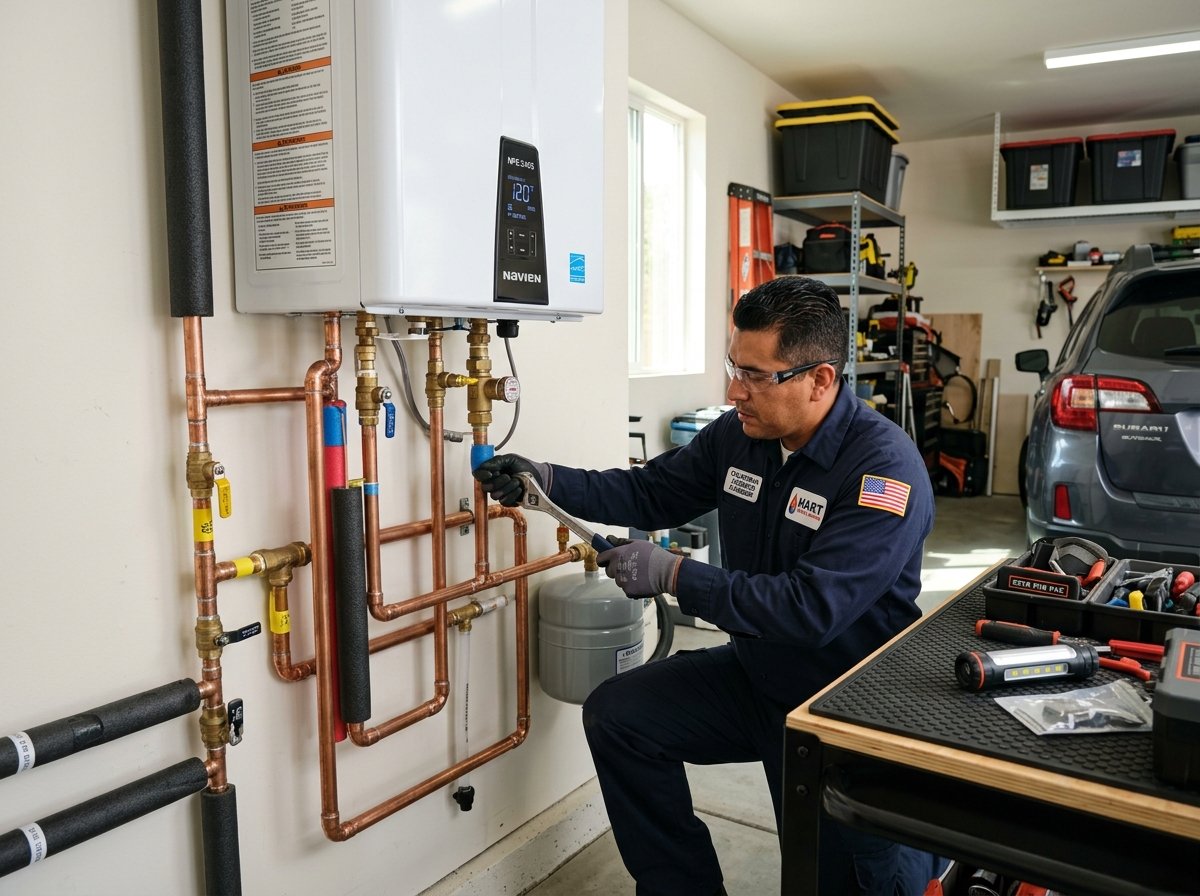
Tankless water heaters heat water as it flows through the equipment rather than storing a large supply in a conventional tank. Choosing the right system requires evaluating household hot water demand, fuel or electrical capacity, installation space, and equipment-specific requirements. Long Beach Water Heater helps homeowners connect with independent service specialists to discuss tankless installation options.
Heats on demand without waiting for storage tank reheat cycles.
High instantaneous BTU or kilowatt energy requirements.
Wall-mounted design frees up valuable residential floor space.
Proper venting, gas lines, and circuit protections are essential.
How Does a Tankless Water Heater Work?
Unlike standard storage tanks that continually maintain 40 to 80 gallons of water at high temperatures, a tankless water heater remains idle until someone turns on a tap. When water starts flowing, the unit initiates an immediate heating sequence designed to deliver steady hot water. The precise sequence varies by model and fuel source.
A Hot Water Fixture Opens
A faucet, shower, washing machine, or dishwasher valve opens in the home, initiating cold water draw through incoming plumbing.
Water Flow Is Detected
An internal flow sensor detects water movement above the unit's minimum activation rate and signals the system's electronic controller.
High-Intensity Heating Ignites
The electronic ignition lights the gas burner or energizes high-output electric heating elements, rapidly heating the internal heat exchanger.
Heated Water Travels to Fixture
Water circulates through high-efficiency heat exchanger pathways, absorbs thermal energy, and flows directly to the calling outlet.
Heating Stops When Demand Ends
When the tap is closed, the flow sensor detects zero flow. Fuel or power is cut immediately, returning the equipment to standby mode.
Gas vs. Electric Tankless Water Heater Installation
Both gas and electric tankless models deliver hot water on demand, but their infrastructure demands differ substantially. Choosing between them requires a careful assessment of your home's current utilities and site logistics.
Gas Tankless Systems
Natural Gas or PropaneGas tankless water heaters utilize high-output burners (often 150,000 to 199,000 BTUs) to heat water rapidly. Because of their high fuel demand, existing gas supply lines and venting must be evaluated carefully.
-
Gas Supply Compatibility: Requires checking gas meter capacity, line sizing, and pressure to confirm the pipe can deliver adequate volume alongside furnaces and ranges.
-
Combustion Venting: Requires dedicated stainless steel or Category IV PVC/polypropylene venting to discharge exhaust gases safely outdoors.
-
Combustion Air: Direct-vent or sealed-combustion configurations must draw adequate outdoor air according to manufacturer specifications.
-
Condensate Management: High-efficiency condensing gas units produce mildly acidic condensate that requires proper drainage or neutralization.
-
Service Accessibility: Requires clear clearance around the burner cabinet and isolation valves for seasonal flushing and filter servicing.
Electric Tankless Systems
240V Multi-Circuit ElectricElectric tankless units use multiple high-wattage heating elements to warm water on the fly. While they require zero combustion venting, their instantaneous electrical amperage draws can be immense.
-
Electrical Panel Capacity: Whole-home units frequently draw 80 to 150 amps, often requiring a 200-amp or larger main electrical service panel.
-
Required Dedicated Circuits: Frequently demands two, three, or four separate dedicated 240-volt double-pole circuit breakers.
-
Wiring Compatibility: Appropriate heavy-gauge copper wiring must be routed from the distribution panel to the heater location.
-
No Venting Footprint: Zero exhaust gases are produced, eliminating flue penetrations through walls or roof structures.
-
Compact Installation: Highly adaptable mounting in indoor utility closets or basements where combustion venting is impractical.
Choosing the Right Tankless Water Heater Size
Tankless sizing is fundamentally different from storage tanks. Instead of sizing for gallons held in reserve, tankless equipment must be sized for peak instantaneous demand under winter ground water temperatures.
Flow Rate (GPM)
Gallons per minute measures water flow through open faucets and appliances. A standard low-flow showerhead draws 1.5 to 2.5 GPM, while bathroom sinks draw 0.5 to 1.5 GPM, and dishwashers draw 1.0 to 2.0 GPM.
Equipment must be rated to support the peak combined GPM of all fixtures expected to run at the exact same moment.
Temperature Rise
The difference between incoming groundwater temperature and the desired hot water output (typically 120°F). In coastal Long Beach, winter incoming water may be 55°F to 60°F, requiring a 60°F to 65°F temperature rise.
The colder the incoming water, the more energy the heater must expend per gallon, which lowers the maximum achievable GPM flow rate.
Simultaneous Demand
Multiple showers or appliances may require hot water at the same time. If a household frequently runs two showers while the washing machine fills, peak demand can easily surpass 6.5 to 8.0 GPM.
Under-sizing leads to temperature drops or reduced flow ("flow throttling") when multiple taps open simultaneously.
Equipment Capacity & Household Usage
Manufacturer performance curves should always be verified under realistic local inlet temperatures rather than theoretical laboratory maximums. Sizing requires reviewing household habits, fixture ratings, and simultaneous usage patterns with a qualified technician.
Is Your Home Ready for Tankless Water Heater Installation?
Before purchasing or installing a tankless water heater, review this comprehensive 10-point home infrastructure checklist to assess compatibility.
Suitable Gas or Electrical Supply
Sufficient gas pipe volume and pressure (often 3/4-inch line minimum for gas) or adequate panel amperage with available 240V breaker capacity for electric units.
Appropriate Water Supply Connections
Cold water feed lines capable of maintaining system operating pressure, along with properly sized hot water manifold distribution pipes.
Adequate Equipment Mounting Space
Sturdy interior wall studs or exterior structural surfaces capable of supporting the wall bracket and operating weight of the unit.
Manufacturer-Required Clearances
Adequate side, top, bottom, and front clearances from combustible walls, windows, doors, and walkways as mandated by the manufacturer manual.
Venting Compatibility for Fuel-Burning Models
Direct venting path through exterior walls or roof using manufacturer-approved venting materials, maintaining legal distances from operable windows.
Condensate Management Where Applicable
Gravity drain or condensate neutralization pump for high-efficiency condensing gas units to safely dispose of acidic moisture byproduct.
Suitable Water Quality Considerations
Municipal water hardness evaluation to prevent premature mineral calcification across tight heat exchanger passages.
Appropriate Service Access
Clear physical access to isolation service valves, inlet filters, and digital controller panels for ongoing routine descaling and diagnostic maintenance.
Required Safety Components
Dedicated pressure relief valve (PRV), gas shut-off valve, thermal expansion controls where required, and sediment traps / drip legs.
Applicable Permits and Inspections
Verification of municipal building and plumbing permit requirements for new gas line runs, electrical modifications, or vent penetrations.
Where Can a Tankless Water Heater Be Installed?
Because tankless systems hang compactly on walls rather than resting on the floor, homeowners enjoy greater flexibility when locating equipment. However, each location must satisfy distinct plumbing, electrical, fuel, and ventilation criteria.
Critical Location Feasibility Factors
Evaluating an installation location involves examining wall mounting suitability, manufacturer minimum clearances from walls and windows, plumbing and gas accessibility, electrical disconnect access, and drainage. In coastal Southern California, freeze protection features should be confirmed for exterior-mounted units during unusual cold snaps.
Never assume an indoor unit can be mounted outside without a dedicated outdoor rating, or that any closet provides adequate combustion airflow.
Switching From a Traditional Tank to a Tankless System
Converting from a conventional 40- or 50-gallon tank water heater to an on-demand tankless unit is one of the most common plumbing upgrades in Long Beach. However, a tankless conversion is rarely a simple "plug-and-play" swap.
Water Quality and Long-Term Tankless Performance
A tankless water heater can provide many years of reliable performance, but its compact heat exchanger is sensitive to mineral buildup. Proper installation planning must account for water conditions and ongoing service access.
Mineral Scale Accumulation
Long Beach tap water contains dissolved minerals like calcium and magnesium. When water is heated rapidly, these minerals precipitate and coat the interior copper or stainless steel heat exchanger passages, restricting flow and reducing heat transfer efficiency over time.
Heat Exchanger Maintenance
To protect the heat exchanger from hot spots and stress fractures, manufacturers recommend routine maintenance, including periodic descaling with food-grade solutions. Installing dedicated service isolation valves during installation makes this procedure straightforward.
Water Treatment Planning
Depending on incoming water hardness levels, installing scale-inhibitor filtration or whole-home water softening can help preserve performance. Assessing water hardness during site evaluation ensures appropriate long-term protection.
What Affects Tankless Water Heater Installation Cost in Long Beach?
Because every residential property features distinct gas piping, electrical panels, and venting routes, installation costs vary significantly based on the work required to prepare the home.
Gas or Electric Equipment Type
Non-condensing gas, condensing gas, and whole-home electric models carry differing upfront hardware and material costs.
Equipment Heating Capacity
Higher GPM-rated units equipped with dual heat exchangers or commercial-grade burners carry higher initial equipment prices.
Gas Supply Upgrades
Upsizing from an existing 1/2-inch gas line to 3/4-inch or 1-inch pipe to satisfy peak burner BTU ratings affects overall scope.
Electrical Panel Upgrades
Electric tankless units frequently require substantial electrical service upgrades (e.g., panel replacement, new sub-panel, or dedicated breakers).
Venting Requirements
Running specialized stainless steel or Category IV direct-vent pipe through roofs, sidewalls, or existing chimney chases adds materials and labor.
Plumbing Modifications
Relocating supply lines, installing isolation service valves, and incorporating thermal expansion controls where required by local code.
Mounting Location & Access
Installing in accessible garage spaces is typically simpler than navigating tight interior closets, crawlspaces, or multi-story configurations.
Condensate Drainage
Condensing gas models require routing dedicated drain lines or installing neutralization pumps if gravity disposal is not readily accessible.
Permits and Inspections
City of Long Beach building and plumbing permit fees, plan checks, and scheduled municipal inspections based on project scope.
Discuss Your Tankless Installation Scope
Installation costs depend on the equipment selected and the conditions of the home. Contact an independent specialist to review your household demand and site requirements.
Call to Discuss Tankless Installation: (562) 271-5637What Happens During Professional Tankless Installation?
Professional tankless installation follows a systematic six-stage process to ensure equipment safety, code compliance, and reliable operation.
Initial Phone Consultation
The homeowner describes their existing hot water setup, household size, concurrent fixture usage habits, fuel preference, and primary installation objectives.
Home Infrastructure Evaluation
A qualified specialist assesses relevant gas meter and piping capacity, electrical service panel headroom, water supply pressure, wall mounting integrity, and potential venting pathways.
Equipment Selection
Appropriate tankless equipment is selected based on household simultaneous GPM demand, winter temperature rise calculations, physical clearances, and homeowner efficiency goals.
Installation Preparation
Qualified professionals prepare the mounting structure, run required gas piping or electrical circuits, core exterior vent penetrations, and configure plumbing drop lines.
Equipment Installation
The selected tankless unit is mounted securely to structural framing, connected to fuel and water lines, equipped with pressure relief protection, and sealed to the vent system per manufacturer specifications.
Testing and System Review
A qualified professional conducts gas leak testing or electrical verification, purges air from lines, verifies electronic ignition, measures water temperatures, and reviews homeowner maintenance procedures.
Important Tankless Water Heater Installation Safety Considerations
Because tankless water heaters handle high-pressure water, high-voltage electricity, and high-BTU gas combustion in a compact enclosure, adherence to safety codes is paramount.
Gas & Electrical Safety
Gas supply connections must be bubble-leak tested and verified under full operating load. High-amperage electric tankless units require appropriate circuit breaker protection and safe isolation disconnects.
Combustion & Carbon Monoxide
Venting must be sealed airtight using certified Category IV materials to prevent dangerous combustion exhaust gases, including odorless carbon monoxide, from entering indoor living areas.
Scald Prevention & Relief
Electronic digital temperature controls help protect household members from sudden scalding. An ASME-rated temperature and pressure relief valve must be installed with proper gravity discharge piping.
Tankless Water Heater Installation Considerations in Long Beach, CA
Installing a tankless water heater in Long Beach involves local factors including municipal building codes, coastal air quality regulations, and varied residential architectures from historic craftsman homes to mid-century properties.
Existing Infrastructure & Housing Stock
Many homes in Long Beach neighborhoods like Belmont Shore, Bixby Knolls, and California Heights feature older 1/2-inch natural gas service lines or 100-amp electrical panels. Evaluating whether gas piping must be enlarged or electrical service upgraded is a vital early step.
Coastal Water Quality & Hardness
The coastal groundwater and imported surface water in Long Beach contain dissolved minerals. Incorporating service isolation valves during installation ensures the heat exchanger can be flushed annually without dismantling copper lines.
California Energy & Low-NOx Rules
Under South Coast Air Quality Management District (SCAQMD) Rule 1121 and Title 24 energy standards, fuel-burning water heaters installed in Long Beach must satisfy strict Ultra-Low NOx emission guidelines and energy efficiency metrics.
Local Permits and Inspections
Tankless water heater installation may require permits and inspections depending on the scope of work and current local requirements. Confirm with the City of Long Beach Building and Safety Bureau or a qualified local professional.
Tankless vs. Traditional Storage Water Heaters
Comparing on-demand tankless equipment against conventional storage tanks helps homeowners weigh installation complexity, space savings, and hot water delivery characteristics.
| Comparison Factor | Tankless Water Heater | Traditional Storage Tank |
|---|---|---|
| How Water Is Heated | Heats water on demand as it circulates through a high-efficiency heat exchanger. | Continuously heats and stores 40 to 80 gallons of water in an insulated tank. |
| Storage Requirements | Zero storage tank footprint; wall-mounted unit frees up interior floor area. | Requires dedicated floor space for large cylindrical tank and safety pan. |
| Hot Water Delivery | Delivers continuous hot water at rated GPM; flow rate is limited by peak capacity. | Provides immediate hot water until stored volume is depleted, then requires reheat time. |
| Installation Complexity | Frequently requires gas line upsizing, specialized venting, or panel upgrades. | Generally simpler direct swap if existing plumbing and venting are intact. |
| Energy Considerations | Eliminates standby thermal heat loss; draws energy only while water is in active use. | Consumes energy periodically throughout day and night to keep reserve water hot. |
| Maintenance Needs | Requires periodic descaling flushes to remove mineral accumulation from heat exchanger. | Requires periodic tank flushing and sacrificial anode rod inspection. |
| Space Requirements | Compact wall-hung enclosure (approx. 28"H x 18"W x 10"D). | Substantial vertical and circular footprint (approx. 60"H x 22" diameter). |
| Equipment Selection Factors | Selected primarily by peak simultaneous GPM demand and temperature rise. | Selected primarily by storage tank gallon volume and first-hour rating (FHR). |
Accuracy note: Tankless systems do not provide unlimited simultaneous hot water. Output is limited by the equipment's rated capacity and operating conditions.
Explore All Long Beach Tankless Water Heater ServicesQuestions to Ask Before Installing a Tankless Water Heater
Use this practical homeowner checklist when consulting with a water heater specialist to ensure your installation plan is thorough and well-engineered.
Tankless Water Heater Installation Assistance in Long Beach and Nearby Communities
Long Beach Water Heater connects homeowners with independent service technicians providing water heater consultations throughout Long Beach and neighboring cities.
Tankless Water Heater Installation FAQs
Find quick answers to common questions about on-demand tankless water heater installation requirements, sizing, and local procedures.
Requirements depend on the selected model and may include suitable gas or electrical capacity, plumbing connections, installation space, venting for fuel-burning equipment, and applicable safety measures.
Often, but the conversion may require infrastructure modifications.
Gas tankless models require appropriate combustion venting. Electric tankless models do not require combustion venting.
Equipment sizing depends on simultaneous water demand, flow rate, temperature rise, and manufacturer performance specifications.
Some models are designed for approved outdoor installations, subject to manufacturer instructions and applicable conditions.
Yes. Maintenance requirements vary by model and water conditions.
Requirements depend on the installation scope and current local rules. Confirm with the appropriate local authority or qualified professional.
Timing depends on equipment selection, existing infrastructure, required modifications, and applicable inspections.
Explore Related Water Heater Services
Whether you need repair, replacement, gas, electric, or heat pump solutions, explore our complete range of specialized water heater services.
Planning Tankless Water Heater Installation in Long Beach?
Whether you are switching from a traditional tank or considering a new on-demand hot water system, Long Beach Water Heater helps homeowners explore available professional installation assistance.