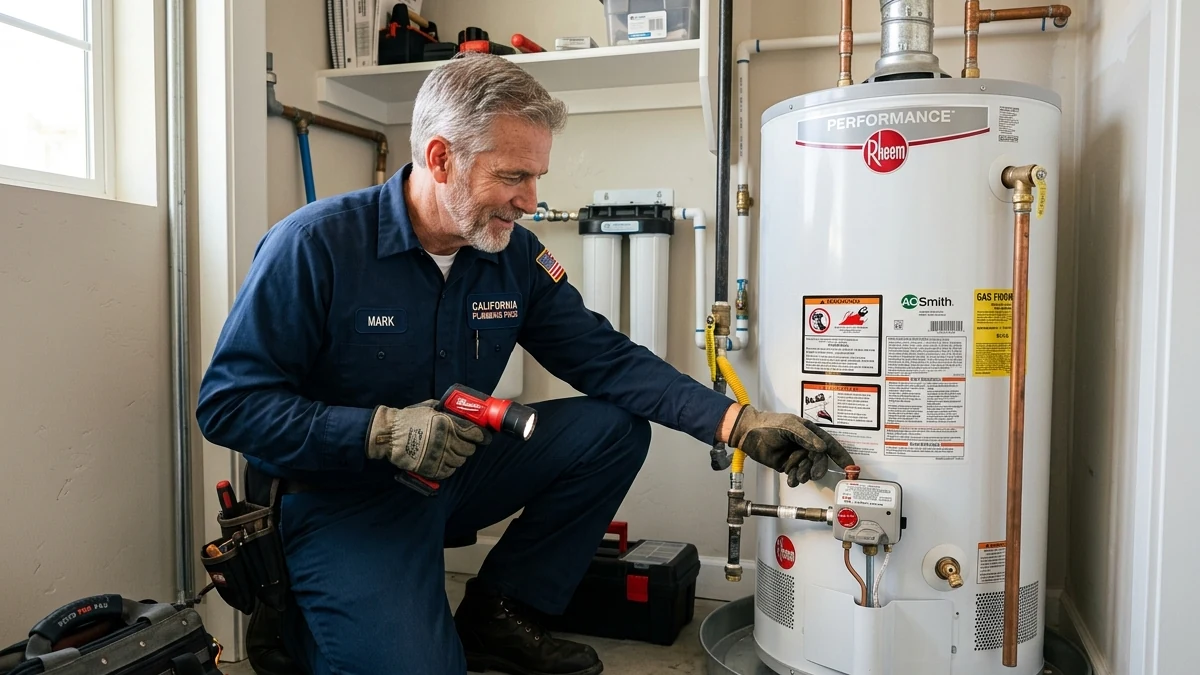
Quick Guide: When & How to Replace Your Anode Rod
A sacrificial anode rod should be inspected every 2 years and replaced when more than 75% of its sacrificial metal is eaten away or the center steel core wire is exposed. In Long Beach (220–300 mg/L mineral hardness), standard magnesium rods often deplete in just 24 to 36 months. Upgrading to a powered titanium anode rod permanently eliminates tank corrosion and stops rotten-egg sulfur smells without ever needing replacement.
- Magnesium Rod: Best overall rust defense for non-smelly water; lasts 2–4 years.
- Aluminum / Zinc Rod: Best budget option for sulfur/rotten egg odor elimination.
- Powered Titanium (Corro-Protec): Permanent electric pulse protection; lasts 20+ years.
The Science of Sacrificial Cathodic Protection
Your water heater tank is fabricated from carbon steel, lined internally with a thin vitreous enamel glass coating. During manufacturing, tiny microscopic cracks (holidays) inevitably form in the glass lining around weld seams, fitting penetrations, and heating element bungs.
When filled with water, galvanic corrosion begins. Water acts as an electrolyte. Under electrochemical principles, the metal with the higher galvanic potential (the less noble metal) will corrode, sacrificing itself to protect the nobler steel tank.
The sacrificial anode rod—typically composed of magnesium, aluminum, or zinc—is submerged directly into the center of the tank. Electrons flow from the anode to the exposed steel, preventing oxidation. In essence, the rod rusts away so your tank does not.
Magnesium vs. Aluminum vs. Powered Titanium
Not all anode rods are created equal. Depending on your home's water chemistry and odor concerns, choosing the right material is essential:
| Anode Rod Type | Galvanic Protection | Average Lifespan (Long Beach) | Sulfur Odor Behavior | Best For |
|---|---|---|---|---|
| Magnesium | Highest (Strongest protective voltage) | 2 to 3 Years | Can worsen sulfur smell if bacteria present | Municipal tap water with no sulfur odor |
| Aluminum / Zinc Alloy | Moderate to Good | 3 to 5 Years | Neutralizes sulfur smell (zinc kills reaction) | Homes with rotten-egg odor or softened water |
| Pure Aluminum | Moderate | 3 to 5 Years | Resistant to high hardness | Budget replacement; leaves aluminum hydroxide sludge |
| Powered Titanium (Corro-Protec) | Active Electrical Current (No depletion) | 20+ Years (Lifetime) | Permanently eliminates sulfur smells in 24 hours | Homeowners who want permanent protection |
Why Long Beach Water Consumes Anode Rods Faster
Tap water in Long Beach contains high concentrations of dissolved total dissolved solids (TDS), specifically calcium, magnesium, and chloride ions. High TDS dramatically increases the electrical conductivity of water.
In highly conductive water, galvanic chemical reactions occur at double or triple the speed of soft water regions. A standard magnesium rod that might last 6 years in Portland or Seattle will often be completely stripped to its bare wire core in just 24 to 30 months in Long Beach. Once the rod is gone, the water aggressively attacks the exposed steel welds, resulting in bottom tank failure.
The 'Rotten Egg' Sulfur Odor Problem
Have you ever turned on the hot water tap and smelled an overwhelming odor of rotten eggs? Many homeowners mistakenly assume their municipal water is tainted. In reality, the smell is almost always a biochemical reaction occurring inside the water heater tank:
- Naturally occurring harmless sulfate-reducing bacteria (SRB) thrive in warm, low-oxygen water heaters.
- As standard magnesium anode rods dissolve, they release free hydrogen ions.
- The bacteria feed on the hydrogen and convert sulfates in the water into hydrogen sulfide gas (H2S)—the chemical compound responsible for the rotten-egg smell.
The Solution: Replace the magnesium rod with an Aluminum/Zinc alloy rod or a Powered Titanium anode rod. The zinc component or titanium electrical current inhibits the bacterial reaction, eliminating the odor permanently.
Tool Warning: The 1-1/16" Hex Head Struggle
Anode rods are installed at the factory using pneumatic impact wrenches, and years of hard water mineral bonding essentially welds the steel threads to the tank fitting. Attempting to loosen an anode rod with a standard ratchet or crescent wrench can twist the entire water heater or snap copper pipes. Professional plumbers use a heavy-duty 1/2-inch cordless impact wrench with a deep 1-1/16" six-point socket, which uses rotational vibration to break the thread bond instantly without straining plumbing pipes.
Step-by-Step Anode Rod Inspection Workflow
If you plan to inspect your anode rod, follow this professional safety procedure:
- Turn off the circuit breaker (electric models) or turn the gas control knob to PILOT or OFF (gas models).
- Shut off the cold water supply valve at the top of the water heater.
- Attach a garden hose to the bottom drain valve and drain 2 to 3 gallons of water into a bucket to relieve pressure.
- Locate the hex head fitting on top of the tank (it may be concealed beneath a plastic knockout cap in the insulation).
- Use a 1-1/16" socket and impact wrench to loosen the hex head counter-clockwise.
- Carefully pull the rod straight up out of the tank. If ceiling clearance is limited, use flexible segmented anode rods for replacement.
- Inspect the rod: if you see more than 6 inches of bare wire core or deep pitting gouges, replace it immediately.
- Wrap new rod threads with 5 to 6 wraps of Teflon tape, thread it in, torque securely, reopen water, purge air from taps, and restore power.
Frequently Asked Questions
Due to local water hardness (220–300 mg/L), you should inspect the anode rod every 2 years and plan for replacement every 2 to 4 years.
Once the sacrificial rod completely dissolves, corrosive water attacks the steel tank directly. The tank will develop pinhole leaks or bottom rupture within 1 to 3 years after the rod expires, requiring a complete water heater replacement.
Yes. Powered titanium anode rods (like Corro-Protec) use an active electrical current rather than sacrificial metal. They never deplete, last 20+ years, and permanently eradicate sulfur rotten-egg odors.
Yes. If ceiling height is less than the 44-inch length of a rigid anode rod, you can install a 'flexible' or 'segmented' anode rod which bends like link sausages as you insert it.
As long as you shut off the incoming cold water valve and drain 2 to 3 gallons to relieve internal pressure, water will not overflow when removing the top hex bolt.