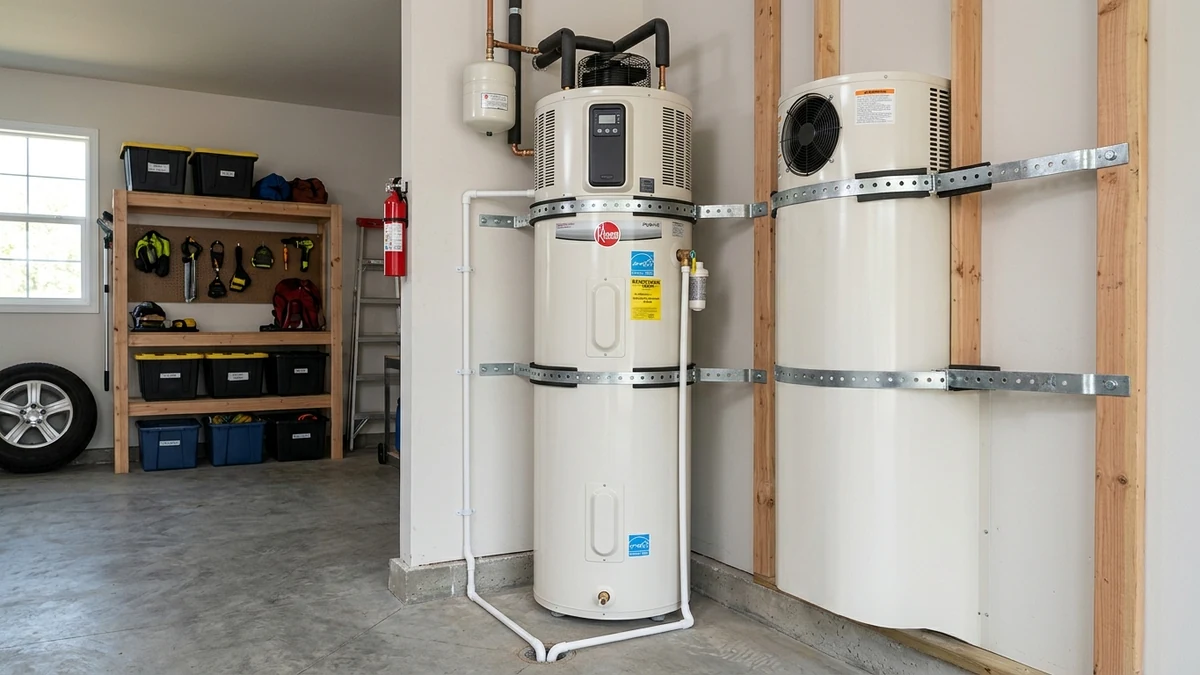
Heat pump water heaters (also known as hybrid electric water heaters) use up to 70% less electricity than conventional electric storage tanks by transferring ambient heat from surrounding air into the water rather than generating heat directly through resistance elements. Operating on a reverse refrigeration cycle with Uniform Energy Factor (UEF) ratings between 3.3 and 4.2, they provide massive energy savings and qualify for federal tax credits and local California rebate incentives.
How Heat Pumps Transfer Thermal Energy
Conventional electric water heaters generate heat by forcing large electrical currents through high-resistance metal elements immersed directly inside the water tank. While electrically 100% efficient at converting electricity to heat, resistance heating requires an enormous amount of power—typically consuming between 3,500 and 4,500 kilowatt-hours (kWh) per year for an average household.
A hybrid heat pump water heater (HPWH) operates on an entirely different thermodynamic principle: instead of generating heat from scratch, it acts like a refrigerator operating in reverse. A top-mounted compressor and fan extract latent heat from the ambient air around the appliance, concentrate that thermal energy through refrigerant phase change, and transfer it directly into the water stored in the tank below.
The Reverse Refrigeration Cycle Explained
Understanding the internal refrigeration mechanics helps property owners appreciate why heat pumps achieve Uniform Energy Factor (UEF) ratings between 3.3 and 4.2—meaning they produce over three to four units of thermal energy for every single unit of electrical energy consumed:
- Air Intake: An evaporative fan draws ambient air across finned evaporator coils containing low-pressure liquid refrigerant (such as R-134a or R-513A).
- Heat Absorption: Because the refrigerant boils at extremely cold temperatures, the ambient room air (even at 50°F to 70°F) warms the refrigerant, causing it to vaporize into a gas.
- Compression: An electric compressor pressurizes the refrigerant gas, dramatically elevating its temperature to 140°F–160°F.
- Heat Exchange: The superheated refrigerant passes through condenser coils wrapped tightly around the steel tank shell, transferring thermal energy into the domestic water supply.
- Expansion: The refrigerant condenses back into a liquid, passes through an expansion valve where pressure drops, and cycles back to the evaporator.
Cooling and Dehumidification Side-Benefit
Because the heat pump removes heat and moisture from the ambient air during operation, it exhausts cool, dehumidified air into the surrounding space. When installed in a Long Beach garage or utility room, this natural byproduct helps keep storage areas noticeably cooler and prevents mold during humid summer months.
Why Heat Pumps Cut Electricity Use by Up to 70%
According to the U.S. Department of Energy, water heating represents roughly 18% of a typical residential energy bill—second only to space heating and air conditioning. Standard electric resistance water heaters draw approximately 4,500 watts when firing. In contrast, an advanced hybrid heat pump operating in pure efficiency mode draws only 400 to 550 watts—less electricity than a standard desktop computer or refrigerator.
For a family of four in Southern California, transitioning from an aging electric resistance tank to a Tier 3 or Tier 4 hybrid heat pump typically saves between $350 and $550 annually in electricity charges under Southern California Edison (SCE) residential rate schedules.
Hybrid Operating Modes: Heat Pump vs. Electric Backup
Modern heat pump water heaters are termed 'hybrid' because they incorporate both the high-efficiency compressor and traditional upper and lower backup electric resistance heating elements. Digital smart control panels allow homeowners to select between multiple operating modes:
- Efficiency / Heat Pump Only Mode: Uses 100% compressor operation to maximize savings. Reheats water efficiently with zero resistance element draw.
- Hybrid / Auto Mode (Recommended): Relies primarily on the heat pump for daily demand, but temporarily energizes electric resistance elements during heavy morning shower rush periods.
- High Demand Mode: Prioritizes rapid recovery over maximum efficiency, activating both compressor and resistance elements simultaneously when guests visit.
- Electric Only Mode: Bypasses the compressor entirely, operating as a standard electric tank if ambient air temperatures drop below operating thresholds.
- Vacation Mode: Drops water temperature to 60°F while you are away, preventing unnecessary energy cycling while protecting against freezing.
Annual Operating Cost Comparison Table
| Water Heater Type | UEF Efficiency Rating | Annual Energy Use | Est. Annual Operating Cost | 10-Year Energy Cost |
|---|---|---|---|---|
| Standard Electric Storage (50 Gal) | 0.92 – 0.95 UEF | 3,800 – 4,400 kWh | $950 – $1,150 | $9,500 – $11,500 |
| Standard Atmospheric Gas (50 Gal) | 0.60 – 0.64 UEF | 220 – 260 Therms | $420 – $540 | $4,200 – $5,400 |
| Condensing Gas Tankless | 0.93 – 0.96 UEF | 150 – 180 Therms | $290 – $380 | $2,900 – $3,800 |
| Hybrid Heat Pump (50–65 Gal) | 3.40 – 4.02 UEF | 900 – 1,200 kWh | $240 – $340 | $2,400 – $3,400 |
Long Beach Coastal Climate: Ideal for Heat Pumps
Heat pump efficiency directly correlates with ambient air temperature: the warmer the surrounding air, the more thermal energy the evaporator coils can harvest with minimal compressor strain.
In cold northern states where winter temperatures regularly plunge below freezing, heat pumps must rely frequently on auxiliary resistance elements. However, in Long Beach and Southern California coastal communities, ambient temperatures rarely dip below 45°F, and garage temperatures consistently hover between 60°F and 85°F year-round. This mild Mediterranean marine climate provides the absolute optimal operating envelope, allowing Long Beach heat pumps to operate in pure heat pump mode virtually 365 days a year.
Frequently Asked Questions
How much electricity does a heat pump water heater really save?
A hybrid heat pump water heater consumes roughly 900 to 1,200 kWh per year compared to 3,800 to 4,400 kWh for a standard electric resistance tank. That represents an approximate 70% reduction in electricity consumption, saving an estimated $350 to $550 every year on utility bills in Southern California.
Do heat pump water heaters make noise when running?
Yes, heat pump water heaters produce a gentle hum similar to a modern kitchen refrigerator or small room air conditioner (typically 45 to 52 decibels). When installed in a garage, basement, or dedicated utility closet, the sound is generally unnoticeable inside primary living areas.
Are there tax credits or rebates for installing a heat pump water heater in Long Beach?
Yes. Qualified Tier 3 and Tier 4 heat pump water heaters are eligible for the Federal Inflation Reduction Act 25C tax credit (up to 30% of project cost, capped at $2,000) as well as California TECH Clean California and local electric utility incentives.
Need Help With Your Water Heater?
Whether you are dealing with hot water loss, diagnosing a strange noise, or planning an energy-efficient upgrade, our certified local plumbing partners across Long Beach, CA are on standby for prompt telephone dispatch.