Sizing a residential water heater depends primarily on your household's peak-hour demand—the maximum volume of hot water needed during the busiest 60 minutes of the day—rather than simple tank capacity. A 2-person household typically requires a 30 to 40-gallon unit (or 50–60 First Hour Rating), a 3 to 4-person family needs a 50-gallon tank (65–75 FHR), and larger households of 5 or more demand a 75-gallon storage tank or a high-capacity tankless water heater delivering 8.0+ Gallons Per Minute (GPM).
- Understanding Peak-Hour Demand & FHR
- Sizing Recommendations by Household Size
- Gas vs. Electric Recovery Speed Differences
- Household Sizing & Capacity Comparison Table
- High-Demand Fixtures & Modern Lifestyle Factors
- California Title 24 & Efficiency Considerations
- Selecting the Right Unit with a Specialist
Understanding Peak-Hour Demand & FHR
When shopping for a new water heater in Long Beach, many homeowners look exclusively at storage gallon capacity (e.g., '40 gallons' or '50 gallons'). However, the plumbing industry measures real-world performance using a far more accurate metric: the First Hour Rating (FHR).
The First Hour Rating measures the total number of gallons of hot water the appliance can supply in one hour of heavy usage, starting with a fully heated tank. It accounts for both the storage volume and how quickly the burner or electric elements can reheat incoming cold water during continuous draw.
To accurately calculate your peak-hour demand, add together all simultaneous hot water activities likely to occur on a busy weekday morning between 6:30 AM and 7:30 AM:
- Standard shower (with water-saving showerhead): ~15–20 gallons
- High-flow rainfall luxury shower: ~25–35 gallons
- Automatic dishwasher cycle: ~6–10 gallons
- Warm/hot washing machine load: ~15–25 gallons
- Food prep and hand sink usage: ~4–8 gallons
Sizing Recommendations by Household Size
Based on typical residential consumption patterns in Long Beach, here is how standard storage tanks align with family sizes:
1 to 2 People: 30 to 40 Gallons (FHR 45–55)
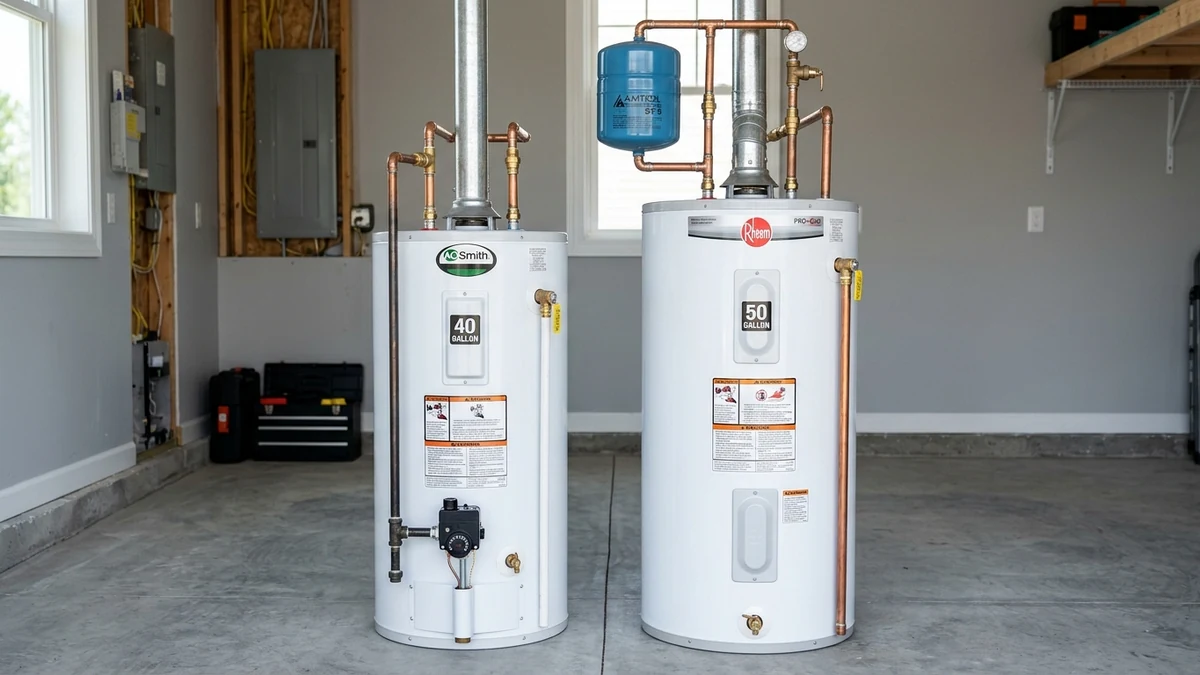
A compact 30-gallon electric or 40-gallon gas water heater easily handles staggered morning showers, a load of laundry, and kitchen cleanup without running dry. Perfect for condominiums, beachfront cottages, and accessory dwelling units (ADUs).
3 to 4 People: 50 Gallons (FHR 65–75)
The standard 50-gallon water heater is the most common residential installation across Southern California. It accommodates back-to-back showers for parents and children while the dishwasher runs simultaneously.
5+ People: 75 Gallons or Tankless (FHR 85+)
For large multi-generational households, homes with oversized soaking tubs, or properties with teenagers taking extended showers, standard 50-gallon units frequently run dry. A commercial-grade 75-gallon storage tank or an on-demand tankless water heater installation providing endless continuous hot water is recommended.
Gas vs. Electric Recovery Speed Differences
The fuel source dramatically alters how a water heater recovers after being drained:
Natural Gas Units: Standard atmospheric natural gas water heaters generate between 38,000 and 42,000 BTUs per hour. They can reheat 30 to 40 gallons of water in roughly 45 to 60 minutes. Because gas recovers much faster, a 40-gallon gas tank often outperforms a 50-gallon electric tank during peak morning routines.
Standard Electric Units: Electric immersion elements (typically dual 4,500W) transfer heat more slowly, requiring 75 to 110 minutes to recover a fully exhausted 50-gallon tank. For this reason, all-electric homes typically require a slightly larger storage capacity or an upgrade to a high-recovery heat pump unit.
Household Sizing & Capacity Comparison Table
Reference this sizing guide when consulting on water heater installation in Long Beach:
| Household Size | Gas Tank Size | Electric Tank Size | Tankless Equivalent (GPM) |
|---|---|---|---|
| 1–2 Occupants | 30–40 Gallons | 40 Gallons | 5.0–6.5 GPM |
| 3–4 Occupants | 40–50 Gallons | 50–55 Gallons | 7.0–8.5 GPM |
| 5+ Occupants | 50–75 Gallons | 65–80 Gallons | 9.0–11.0 GPM |
High-Demand Fixtures & Modern Lifestyle Factors
Modern home remodeling trends introduce high-demand plumbing fixtures that overwhelm standard sizing formulas:
- Freestanding Soaking Tubs: Roman tubs and deep soaking vessels can hold 60 to 80 gallons of water. A single bath can completely drain a 50-gallon water heater before filling, leaving no hot water for the rest of the house.
- Multi-Head Shower Systems: Walk-in showers equipped with a overhead rain fixture and two body sprays consume 5 to 7 GPM—triple the volume of a standard low-flow showerhead.
California Title 24 & Efficiency Considerations
Under California Title 24 energy efficiency standards, water heaters installed in Long Beach must meet strict Uniform Energy Factor (UEF) minimums. Storage tanks larger than 55 gallons face stringent energy mandates, making hybrid heat pumps or condensing tankless systems the preferred modern compliance pathway.
Selecting the Right Unit with a Specialist
Undersizing a water heater leads to perpetual cold showers and family friction, while oversizing wastes standby energy heating unused water. Our certified local installation partners assess your fixtures, gas supply volume, and daily routines to recommend the ideal, code-compliant water heater for your Long Beach residence.
Frequently Asked Questions
Is a 40-gallon water heater big enough for a family of 4 in Long Beach?
A 40-gallon gas water heater can support a family of 4 only if showers are staggered. However, if multiple family members shower within the same 30-minute window while the washer runs, a 50-gallon unit is strongly recommended.
What is the difference between storage capacity and First Hour Rating?
Storage capacity is the static volume of water held inside the cylinder. The First Hour Rating (FHR) is the total usable hot water delivered during an hour of heavy draw, combining stored hot water with newly reheated volume.
How does water temperature affect sizing in Southern California?
Long Beach groundwater temperatures average a mild 60°F to 65°F year-round. Because incoming water is warmer than in northern climates, water heaters require less energy to reach 120°F, improving recovery performance.
Need Help With Your Water Heater?
Whether you are dealing with hot water loss, diagnosing a strange noise, or planning an energy-efficient upgrade, our certified local plumbing partners across Long Beach, CA are on standby for prompt telephone dispatch.